Did you know?
80% of Scotland's 11 million mature ash trees will be lost over the next two decades due to ash dieback disease.
We're working to create a Scotland where woods and trees thrive for people and nature. Our mission is to protect native woodland, restore vital habitats and plant more trees. Find out about our vision for Scotland's landscapes.
80% of Scotland's 11 million mature ash trees will be lost over the next two decades due to ash dieback disease.
Ancient woodlands are some of the richest places for nature in Scotland.
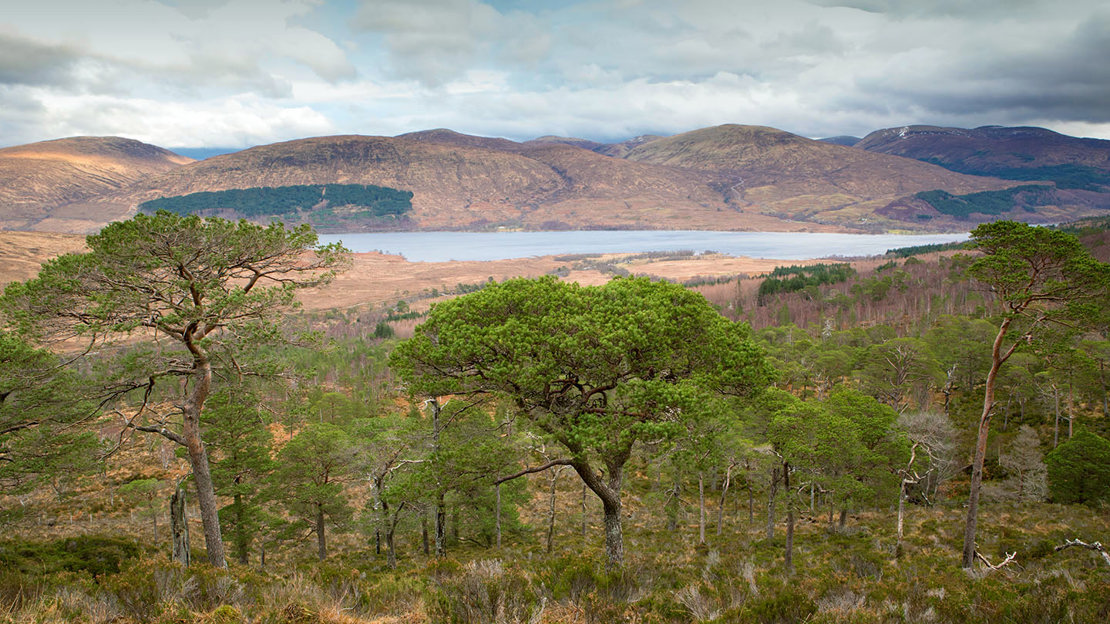
Ancient trees are complex ecosystems in themselves and there is such a diverse range of ancient woodland habitats, from humid temperate rainforest to our iconic Caledonian pinewoods.
Sadly, many ancient woodlands are in poor shape, suffering from threats such as:
We want Scotland's ancient woodlands to be protected, restored, expanded and connected to create thriving, resilient ecosystems. Our analysis suggests that Scotland has enough land to expand native tree cover from around 5% currently to 16%, and that this can be done in a way that maintains food production and increases softwood timber production.
Over 40% of Scotland's rainforest is grazed so heavily that natural regeneration is unlikely to occur.
We're working hard to protect ancient woods from future threats by creating new native woodland and linking it to existing ancient woodland. We're also taking steps to:
Loch Arkaig Pine Forest was planted with fast growing non-native conifers after the Second World War. These conifers have shaded out ground flora and made it impossible for some native trees to survive. But by 2026, we'll have removed 85,000 tonnes of these plantation trees from the 2,500-acre forest, opening up areas for native plants to flourish.
If you're a landowner wishing to restore ancient woodland in Scotland, we can help you get started.
For advice on ancient woodland restoration or for opportunities to join a site visit, please contact Scotland@woodlandtrust.org.uk. Or, if you're interested in learning practical skills, we've collaborated with Cumbria Woodlands to develop an online training course in ancient woodland restoration.


Practical guidance
PDF (582 KB)
About us
We're working to ensure Scotland’s rainforests thrive once again. As part of the Alliance for Scotland’s Rainforest, we're on a mission to protect and enhance this globally important habitat for the special wildlife that depends upon it.
Around 25% of Scotland’s land is used for arable production, horticultural production and for improved grassland that supports dairy, sheep and beef.
Trees and hedgerows are one of the most significant ways of boosting nature and sequestering carbon on farms and crofts.
They can also boost farm productivity by providing shelter for livestock, enhancing water retention, reducing soil erosion and producing valuable materials such as timber, wood chip bedding, firewood, fodder and fruit.
We want Scotland’s farms and crofts to be rich in native trees and hedges, integrated into farming systems in ways that support nature restoration and food production.

More than 6,000 miles of hedgerow have been lost in Scotland in the last century – around half of what we once had.
Glen Finglas is home to a rare habitat type known as wood pasture – areas of grassland between veteran trees – the result of management over centuries by people who grazed their livestock and carefully cut and pollarded the trees.
Today, a herd of hardy Luing cattle help us manage the wood pasture at Glen Finglas by grazing amongst the old trees from May to September. The trees provide shelter, shade and small amounts of fodder or ‘browse’ for the cattle. In exchange, the cattle keep the grass short and provide fertiliser for the soil and wildflowers, while their hooves disturb the soil and help create seed beds for ground flora and trees.
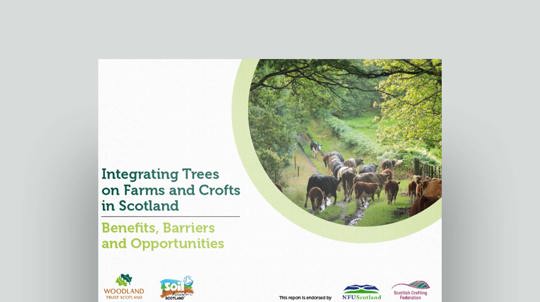
In collaboration with Soil Association Scotland and Scottish farmers and crofters, we have developed clear recommendations for the Scottish Government on how future farm support can significantly increase trees on farms and crofts. We’re delighted that these recommendations are endorsed by the National Farmers Union Scotland and the Scottish Crofting Federation.
The Integrating Trees Network is a farmer-led initiative that hosts farm visits and online workshops for farmers and crofters who are keen to learn more about the benefits and practicalities of trees on farms and crofts.
We offer grants for small woods on farms, a special grant scheme for small woods on crofts, and grants for hedgerows on farms.
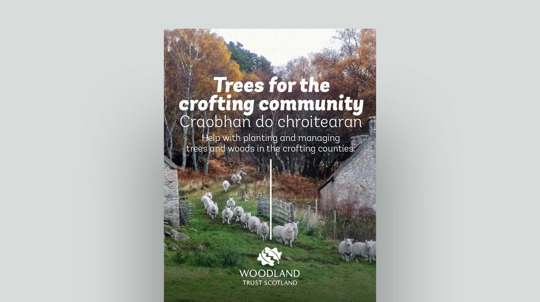
For our specialist advice on trees on crofts contact crofting@woodlandtrust.org.uk.
Across Scotland’s 125,000km of baseline river network, 56% of riverbank vegetation is in poor condition, without any trees or shrubs.
Diverse, resilient river woodlands are vital for the health of Scotland’s rivers.
They protect against bank erosion, reduce fertiliser and sediment pollution, reduce flood peaks, keep water cool in a warming climate and help create diverse habitats for fish and other aquatic life.
We want Scotland to have a thriving network of river woods, supporting healthy river ecosystems and creating 'green arteries' which connect habitats and allow species migration across the country. 175,000 hectares of land along Scotland’s river network have been identified as having the potential for new river wood creation.

On the banks of Loch Ness, Urquhart Bay is one of the best examples of surviving ancient wet woodland in Europe. This low-lying, intact floodplain is also one of the best examples of alluvial woodland in the UK.
It is connected to a dynamic river system that experiences frequent flooding. As well as altering river channels, creating static ponds and leaving accumulations of fallen trees and woody debris on the woodland floor, these floods wash the seeds of invasive plants from neighbouring gardens downstream, where they colonise bare, eroded ground.
Despite our best efforts, invasive Japanese knotweed and Himalayan balsam have so far proven to be extremely difficult to eradicate. Our long-term management seeks to maintain a biologically rich alluvial woodland with a varied woodland structure, diverse ground flora and frequent deadwood.
We're part of the Riverwoods collaborative – a network of partners working to create a practical blueprint for river woodland restoration across Scotland.
Together, we're currently developing a toolkit to help landowners create river woods. We're also exploring opportunities for catchment-scale river wood creation in the Ericht catchment, as well as supporting partner organisations working on the River Tweed and the River Dee. Given the importance of river woods, we are calling on the Scottish Government to develop a bespoke river wood grant scheme.
If you're looking to plant or restore river woodland, our team of experts can advise on planning, helping you plant the right tree in the right place. We also offer funding for watercourse planting and restoration, and you may be able to take advantage of our MOREwoods scheme.
If you have a potential new river wood creation project of 10 hectares or more, we may be able to part fund your project through our woodland carbon offer. Contact us at carbon@woodlandtrust.org.uk for more details.
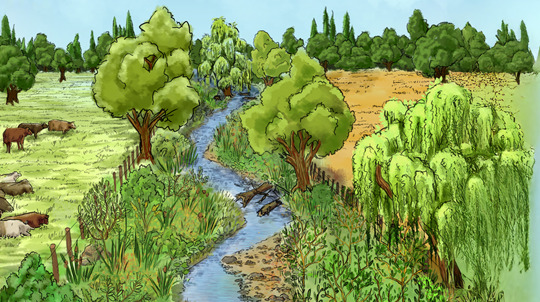
Plant trees
Planting trees along rivers and streams can reduce flooding and improve the health of waterways. Discover the benefits for farms and the environment.

Practical guidance
PDF (4.41 MB)
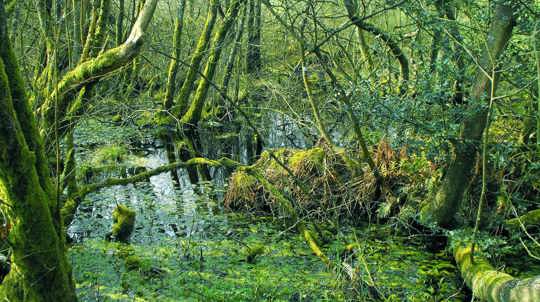
Trees woods and wildlife
Wild, transient, boggy and rare. Wet woodlands are now some of our least common wooded habitats. Learn about these special places and why they are so important to wildlife.
The urban forest includes trees in parks and gardens, schools and streets, urban woodlands and along canals and rivers, as well as the naturally regenerating trees and shrubs that grow in the nooks and crannies of the urban landscape.
Trees in our towns and cities are a vital refuge for nature, play a valuable role in supporting physical and mental health and are increasingly important in helping us adapt to a warming climate by keeping people and buildings cool. Sadly, people of lower socio-economic status currently have less access to the benefits of trees and woods. We want that to change.
We want the benefits of urban woods and trees to be available to everyone, regardless of where they live or their socio-economic status. To help make this happen, we've launched a Trees for All action plan for Scotland, setting out the steps required to ensure every neighbourhood has full and fair access to trees in towns and cities.

Our landholding in Livingston includes over 50 woodland parcels covering over 160 hectares. These important green pockets create vital links between built-up areas and offer a refuge for residents, visitors and wildlife within what can be a hectic urban environment.
We are delighted to be working with West Lothian Council on our first Trees for All project focused on Craigshill, and plan to use one of our own urban woods to inspire community action to improve canopy cover in surrounding areas of low tree equity. Project development is well underway, and we hope to start delivery in 2026.
We have supported the development of the Clyde and Forth Climate Forests to significantly increase tree cover across Central Scotland, as well as funding the Edinburgh Million Tree City project.
We provide free trees to schools and communities for local community planting projects. We also support local authorities and planners in using the Tree Equity Score tool to focus tree planting in towns and cities where it will have the greatest impact for people. Contact us at treeequityscotland@woodlandtrust.org.uk for more information.

About us
We believe everyone in Scotland deserves to enjoy the benefits of trees. And with over 4.3 million Scots living in towns and cities, equal access to nature has never been more important.

Trees woods and wildlife
Street trees and local woods add colour, life and pollution protection to towns and cities. Find out more about them and what urban wildlife they support.

Position statement
PDF (2.01 MB)
Uplands are commonly defined as land above the level of agricultural enclosure, typically 300-400m above sea level but often lower.
In Scotland, uplands cover more than 50% of the country, comprising a diverse range of habitats and playing a major role in Scotland’s nature recovery.
We want to see Scotland’s uplands with significantly greater native tree cover, forming mosaics with other natural habitats such as restored peatland, moorland and grassland. Upland farming, forestry and sporting will continue to support rural livelihoods and communities as they move to more nature-positive approaches.

Gleann Shìldeag is home to a mosaic of habitats including mountains, heathlands, blanket bog, ravines and patches of broadleaf trees. Once densely forested, today only individual trees and fragments of scattered woodland remain. But there’s huge potential for native woodland expansion.
We’re using a combination of natural regeneration, new native planting and effective deer management to expand the woodland to cover 35% of the estate. Two phases of planting are already complete, with a staggering 428,000 trees going in the ground thanks to the help of community members, schoolchildren, volunteers, contractors and supporters from across Scotland.
In 2026 we'll be consulting on our plans for a third phase of native woodland creation, developing our local tree nursery and trialling the planting of specialist montane species including dwarf birch and whortle-leaved willow in an effort to reestablish montane scrub – habitat which exists above the tree line.
Montane scrub supports a range of unusual upland plants but is almost entirely absent in Scotland due to grazing by red deer and sheep.
We are excited to have entered into a 30-year collaboration with the community-run Assynt Foundation to support woodland restoration and expansion across this iconic landscape.
We're also proud to support the Common Ground Forum, an award-winning initiative to bring together land and deer managers to develop collaborative approaches to deer management, based on mutual respect and consensus building.
And together with Trees for Life, our three-year Tree Seed Collection project is working with over 80 volunteers, as well as montane and niche tree species specialists, to collect seeds from targeted areas, including temperate rainforest. It is not always possible to find native trees of the right species and regional genetics (provenance) for woodland expansion, but this project is helping to make that easier.
If you're looking to plant or restore woodland in upland areas, our team of experts can advise on the planning, helping you plant the right tree in the right place. You may be able to take advantage of our MOREwoods scheme, and there are specific country and regional grants available too.
If you have a potential new woodland creation project of 10 hectares or more, we may be able to part fund your project through our woodland carbon offer. Contact us at carbon@woodlandtrust.org.uk for more details.

Trees woods and wildlife
Heathland and moorland are characterised by a lack of trees. These open and wild landscapes have been shaped by human management. Find out more.
Practical guidance
PDF (42.34 MB)

Position statement
PDF (70 KB)