

Buy British trees from our shop
We have single trees and tree packs to meet your needs, from wildlife to woodfuel. Delivery is free.
Shop now
Digital Content Manager
Without their characteristic blossom or leaves, winter trees become tricky to identify. Thankfully, our winter tree ID guide can help with that!
Below, you’ll find advice about the key features that can help you identify trees in winter, as well as tips for recognising specific species.
When you can’t identify trees by their leaves, you must rely on other features to tell them apart from their neighbours.
Bark: Look closely at the texture, markings and colour. Is it smooth and shiny? Is it peeling away? Is it cracked and patterned with deep ridges?
Buds: How are they arranged along the tree branch? Alternate buds are arranged in turn on opposite sides of the stem; opposite buds sit in pairs, directly opposite each other, on either side of the stem; and spiral buds grow alternately around the stem in a spiralling pattern. Some buds may also have a distinctive appearance, like purple-black ash buds or sticky horse chestnut buds.
Twigs: Texture is a big giveaway. Are they smooth, ridged, hairy or covered in spines or thorns?
Size and shape: Some trees have a distinctive look, even at a distance. For example, silver birch is narrow, with a light crown, while oak has an impressive, broadly-spreading crown.
It’s also worth checking the ground immediately below a tree for tell-tale clues. Even in the depths of winter there may still be fallen nuts, seeds, fruit and mast which reveal a tree’s identity.
Now you know the basics, here’s our guide to identifying seven common trees in winter.

Ash is one of the more distinctive winter trees thanks to its coal-black, velvety leaf buds. They’re arranged opposite each other on smooth twigs which range from pale brown to grey in colour. Earlier in winter you may also spot winged fruits, known as ‘keys’, hanging in bunches from the branches.
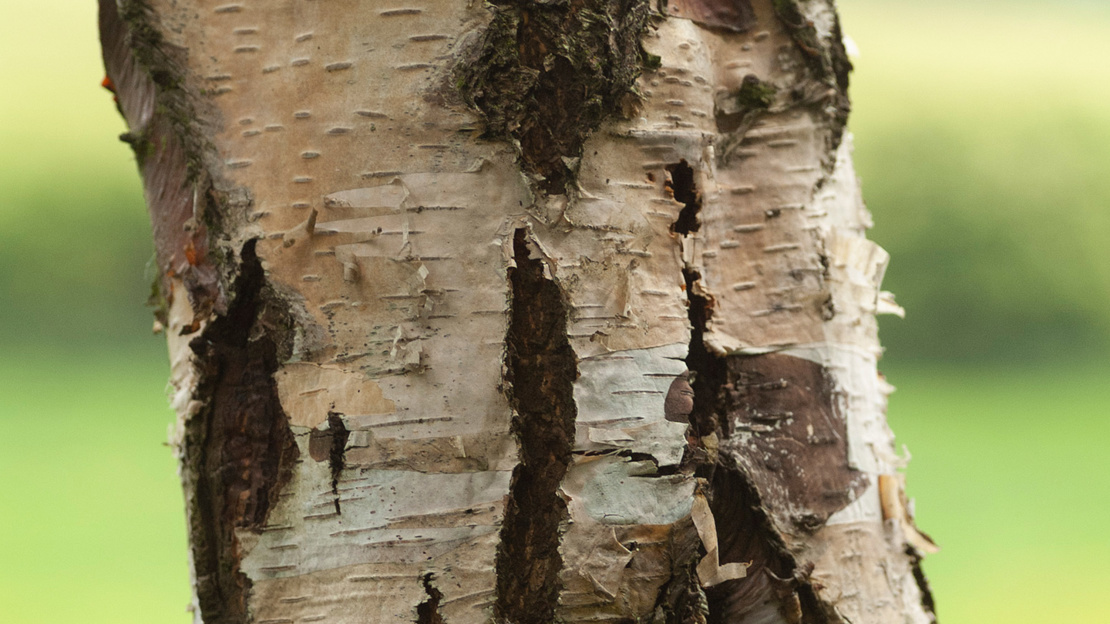
The distinctive bright white, papery bark of silver birch peels and sheds layers. Over time, the bark develops dark, diamond-shaped fissures and becomes black at the base of the tree. Older silver birch trees can also be identified using their characteristic silhouette – tall and thin, with a light canopy of drooping branches.

Dogwood is a welcome sight in the largely grey and gloomy winter months. Young branches are a striking bright red colour, while older bark is smooth and grey-brown, with white spots or patches which become more prominent with age. Its beauty makes dogwood a popular garden shrub, and you’re also likely to spot it in hedgerows and along woodland edges.
We have single trees and tree packs to meet your needs, from wildlife to woodfuel. Delivery is free.
Shop now
Beech is quite unique amongst deciduous trees because it can hold onto its dead leaves in winter, a phenomenon known as marcescence. If you come across a beech which has dropped most of its leaves, look for them – along with discarded beech mast – around the trunk. If all else fails, its leaf buds are very distinct – sharply pointed, held away from the twigs at an angle, and reddish brown with a criss-cross pattern.
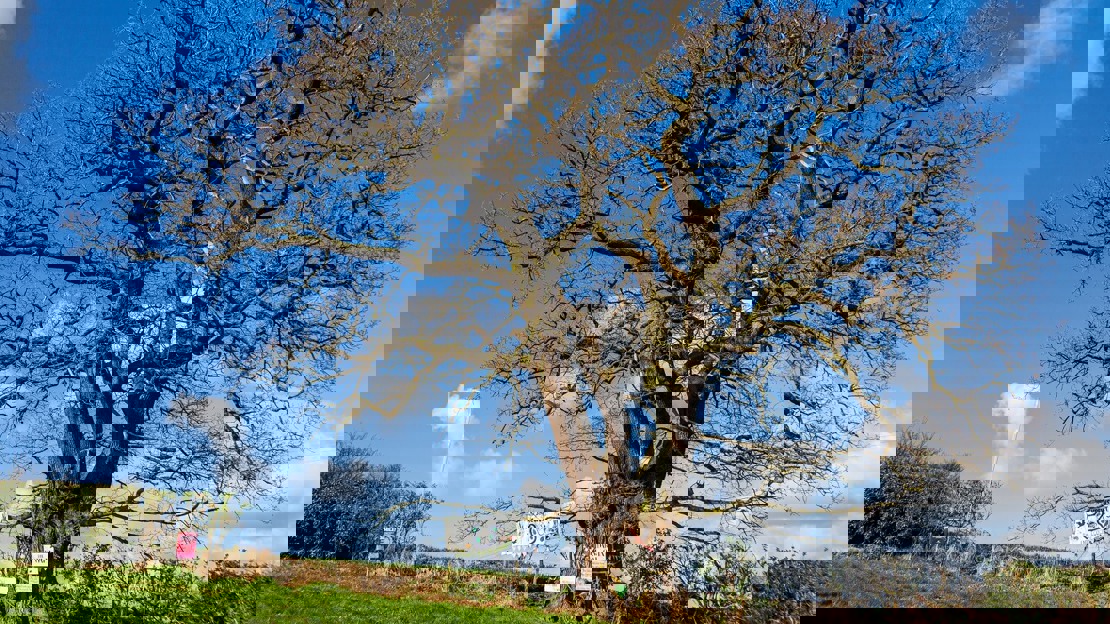
Also known as the common oak or pedunculate oak, English oak can be a tricky winter tree to identify. First, look at its silhouette – mature English oaks have a broad, spreading crown with sturdy branches underneath. If you still aren’t sure which tree you’re looking at, examine its buds. They’re rounded and form in clusters, and each bud has at least eight scales.

Once the sweet chestnut’s spiky seedcases have fallen to the ground, the best way to identify this tree in winter is its bark, which has deep fissures spiralling upwards around the trunk. Like English oak, the sweet chestnut also has a recognisable silhouette – an oval-shaped crown, and a height up to 35 metres.

Laden with conkers in autumn but bare once winter arrives, the best way to identify horse chestnut is by looking at its bark and branches. The bark forms into grey-brown, flaky scales, while the twigs are tipped by dark red, sticky oval buds.


Use our free Tree ID app for Android and iPhone to identify the UK's native and non-native trees.

Blog
Helen Keating • 17 Dec 2020
Blog
Charlotte Varela • 30 Sept 2023
Blog
Rachel Hoskins • 14 Mar 2020

Blog
Helen Keating • 03 Jun 2021
Blog
Helen Keating • 21 Sept 2020
Blog
Danielle Wesley • 02 Mar 2020
Blog
Helen Keating • 13 Jul 2020